
Religious Workers Visa to the US – R-1 Visa

Deprecated: Function get_the_author_ID is deprecated since version 2.8.0! Use get_the_author_meta('ID') instead. in /var/www/sites/lawfirmbackup_200125/wordpress/wp-includes/functions.php on line 6131
How can a religious worker, such as a rabbi, cantor, priest, or other spiritual leader, perform their duties within the United States? The US offers a specific work visa for religious workers, known as the R-1 visa. The US religious worker visa (R1 visa) allows for a total stay of up to 5 years, with the possibility of bringing family members as dependents and the option to eventually apply for a green card for religious workers.
Who is eligible for a US religious worker visa? How can one prove eligibility and obtain the visa in practice? What are the conditions of the visa, and how can a religious worker get a green card after receiving this visa?
All details are covered in this article by a US immigration attorney from Decker, Pex, Levi law firm, with offices in Tel Aviv and Jerusalem.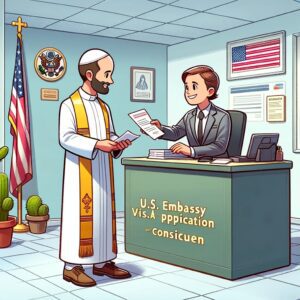
Who is eligible to receive a US religious worker visa?
This question is more complicated than it seems. A “religious worker” for the purposes of obtaining an R visa is a person engaged in religious or spiritual missions within a religious organization recognized by US authorities (see below).
There are two important parts to the definition:
On one hand, the religious worker must be employed (the visa is not for volunteers) for at least 20 hours a week by a recognized non-profit religious organization. The religious organization invites the worker to apply for the R-1 visa. The worker must have been a member of the organization for at least two years at the time of the R-1 visa application. The religious worker cannot hold additional employment in the US with this visa.
On the other hand, the employment offer itself must focus on religious or spiritual activity. This means the worker can be a rabbi or a priest, but also a teacher or another worker in a religious organization (cantor, spiritual mentor, etc.) as long as the job is directly related to religion. The visa is not granted for physical or administrative work (such as renovations or accounting) at a religious institution. Essentially, the work involves conducting religious ceremonies and fulfilling religious leadership roles.
Examples of roles eligible for a US religious worker visa include kashrut supervisors, cantors, heads of yeshivas, Jewish studies teachers, priests, choir directors or musicians in churches, doctors and nurses in religious hospitals, missionaries, etc.
What is a “recognized religious institution”?
Unlike in Israel, the US does not have a list of recognized religious denominations, and immigration authorities do not attempt to define what constitutes a true religion versus a single-person cult. This responsibility is given to a more qualified authority—the IRS. The main requirement for a sponsoring institution to be recognized as a religious organization is to obtain recognized and tax-exempt status from the US IRS.
How to practically obtain a US R-1 religious worker visa?
The recognized religious organization or community in the US issues an invitation for the religious worker. The organization fills out Form 129 and submits it to the Department of Homeland Security (DHS), receives an approval number (Form I-797), and forwards it to the visa applicant, who presents it during the embassy interview. Additionally, the organization provides an official invitation letter detailing the worker’s qualifications for the role in the US—previous experience, official spiritual title (whether a degree in theology, record of yeshiva studies, or ordination as a priest), job contract terms, and salary. Both the organization and the worker must explain how the worker and any accompanying family members will support themselves in the US.
The visa applicant must fill out Form D-160 and attend an interview at the consulate with the required documents and approvals. During the interview, they must explain their intention to work in a recognized and tax-exempt religious organization in the US, have previous work experience in a similar role (at least two years), and that the religious organization has officially invited them to the position. Additionally, they must demonstrate the ability to support themselves and any accompanying family members. As with any other US visa applicant, they must prove they have no criminal record or previous violations of US immigration policy.
Also, ensure that your passport is valid for at least six months after the visa’s validity and that you have an up-to-date passport-style photo.
How long does it take to obtain a US religious worker visa?
On average, about 9 months. It takes around 6 months for immigration authorities (USCIS) to begin processing the application and about 3 months to complete the process.
What are the conditions of the US religious worker visa?
The R-1 visa is granted for 30 months (two and a half years), with the possibility of renewal up to 60 months (5 years). Unlike some other visas, there is no limit on the number of religious workers who can receive this visa each year.
Holders of this visa can travel in and out of the US without restrictions as long as the visa is valid. Additionally, the visa’s validity covers the period the worker is physically present in the US.
The visa holder can bring a spouse and minor children (under 21) with an R-2 dependent visa. R-2 visa holders can live and study in the US but cannot work.
Finally, the R-1 visa is a non-immigrant visa with “dual intent.” This means that while the time spent in the US with this visa does not count towards eligibility for permanent residency (green card) or US citizenship, there is an option to legally obtain a religious worker immigration visa/green card (EB-4) after residing in the US with an R-1 visa.
Contact a US Immigration Expert
If a religious organization you work with needs to bring a religious worker to the US, contact us for practical assistance and advice on obtaining an R-1 visa for this purpose. Our offices in Jerusalem and Tel Aviv are at your service.

 :
: :
:מאמרים מומלצים